Monday, June 24, 2013

Super Moon Over Kitt Peak National Observatory


Kitt Peak National Observatory is located 56 miles southwest of Tucson Arizona in the Quinlan Mountains. I live more than 50 miles away from the observatory but I can see it from where I live. Kitt Peak is home to the worlds largest collection of telescopes including the Mayall 4 meter telescope and the McMath-Pierce Solar Telescope.


McMath-Pierce Solar Telescope

I have made several trips to Kitt Peak for the amazing views and to be able to check out the telescopes and one of my favorite things to do while I am there is visit the observation deck of the Mayall telescope which is open to the public and affords a 360 degree views of the surrounding Sonoran Desert.


I highly recommend that if you are in the area you take a trip to the observatory. You can access a virtual tour of Kitt Peak National Observatory at: http://www.noao.edu/outreach/kptour/. The entire trip from Tucson can be done in 5 or 6 hours and I recommend you take a picnic lunch and be prepared to see some spectacular scenery as well some very fascinating science.


Sunday, June 23, 2013

Arizona- Sonora Desert Museums Newest Resident


Presently 6 1/2 months old this male was rescued in San Jose, California weighing only 15 pounds. The Desert Museum has provided the following information on it's new resident: http://www.desertmuseum.org/ml/background.php

Saturday, June 22, 2013

Bird Watching at Cochise Lakes Willcox Arizona


We took a ride out to Willcox Arizona on business and to get a piece of apple pie alamode at Apple Annie's new country store and decided to make a quick stop at Twin Lakes to check out the birds. I've only been here a couple of times but each time there were plenty of birds to see. Black-necked Stilts were in abundance, perhaps 30 or 40 in all. According to the maps in Sibley stilts summer in a small area of south eastern Arizona and migrate throughout the state. I have seen many here in Tucson at Sweetwater Wetlands. Check out Black-necked Stilts at: http://www.allaboutbirds.org/guide/Black-necked_Stilt/id


There were Kildeers and what looked like plovers but the lighting was very difficult so I can't be sure of an I.D. Also spotted a single White-faced Ibis feeding along the sand bar which can be seen in the photo below. Information on Kildeers: http://www.allaboutbirds.org/guide/killdeer/id


The following is a description of the area by the Southern Arizona Birding Organization.

"At the northern end of the valley, on the east side of the city of Willcox, is Cochise Lakes (a.k.a. Twin Lakes) a pair of effluent ponds adjacent to the municipal golf course on the east side of the city of Willcox. These ponds, ranging from shallow and ephemeral to deep enough for grebes and diving ducks, provide habitat for a variety of migrant and wintering waterfowl and shorebirds. The ponds are deep enough to support diving species such as Canvasback, Ring-necked Duck, Lesser Scaup, Redhead, Common Merganser, and Western and Clark's Grebe. In winter, Sandhill Cranes can sometimes be seen loafing in the grasslands nearby in the afternoons. This is a very popular birding stop from August through May, but be aware that the route around the lakes is not paved and is treacherous when wet. The city of Willcox has recently begun to develop visitor access to this site; please sign in at the visitor register at the entrance.


As you can see the town has provided blinds for close up watching. The birds on the island are mostly American Avocets which also summer in a small area of southeastern Arizona. Read about American Avocets at: http://www.allaboutbirds.org/guide/American_Avocet/id

Thursday, June 6, 2013

Female Costa's Hummingbird Building Nest

It's been a busy week here in my Sonoran Desert yard. Some of you may already know that I live on the border of Tucson Mountain Park in Tucson Az. not far from Saguaro National Park West. It's been above 100 degrees here all week so I get outside around 6 A.M. to do my yard work and make sure that water is available for all my daily visitors. First I make sure that the bird bath which is placed on the ground is clean and filled. If it's starting to grow things I use bleach and a tooth brush to scrub it and then I rinse it exceptionally well before filling. Because we get so little rain this time of year I have a varied and a sometimes unusual parade of visitors hoping for a drink. As you can clearly see I live in a residential area that was carved out of the desert many years before I arrived here in Tucson. Nearness to the park puts us in a locale that has close proximity to wildlife so visitors like these Mule Deer while not the norm pay us an occasional visit. Today promises to be 106 degrees maybe more so it will be important to keep the water filled. I usually change it 3 or 4 times a day as needed.


It has been an unusual season for Diamondback Rattlesnakes having encountered two here in the yard and one at the Desert Museum. The two in the yard were very young perhaps from the same hatch so I suspect that their might be a den somewhere nearby. Young rattlesnakes can travel up to a mile from their den and adults up to three miles in search of food.
Gambel Quails have been visiting the watering hole for a couple of months in pairs and family groups and only rarely solitary individuals. This week they have started showing up with the tiniest of chicks in tow. I have seen 2, 3 and 7 chicks in different family coveys.
We have the usual assortment of Mourning and White Winged Doves, House Finches, English Sparrows, Lesser Goldfinches, Goldfinches, Verdins, Northern Cardinals, Mockingbirds, Gila Woodpeckers with occasional visits from Phyrraloxia, Phainopepla, Hooded Oriole, Bullocks Orioles, Cottontail Rabbits, assorted Lizards and a very disruptive Coopers Hawk. My favorite visitors are however the hummingbirds.


At this very moment a female Costa's is building a nest outside my workroom window. Females are really hard to identify and I have spent the last couple of days trying to decide if she was a Costa's or a Black-chinned. I finally concluded she was a Costa's for two reasons. She has faint spotting on her breast and there is a male Costa's hanging around who is not being aggressive towards her. Males are very aggressive toward any other hummingbird that is in their territory. There is a daily battle raging as other hummers try to get a drink at the feeders.
 Here in Arizona there are 17 different hummingbirds. Some are rare and localized and some are common depending on the time of year. So far I have managed to see 8 different varieties including a Blue-throated Hummingbird in Patagonia. There are at least five different hummers who frequent my three feeders here at the house and I have seen two other attempts to nest in the yard but both were unsuccessful due to high winds. Hopefully this time i will get to watch the entire process from nest building to egg laying and hatching and finally fledging. I'm keeping my fingers crossed.

Note: Sadly the hummingbird nest was abandoned with two tiny eggs after several days of temps above 105 degrees. Mama spent all day each day sitting in the sun keeping the eggs shaded but I suspect that it was too much for her as she just disappeared. It's possible that some other harm befell her but I will never really know for sure. Of the three attempts that I have witnessed of hummers nesting in the Oleanders all three have failed. I am beginning to wonder if Oleanders are unsuitable nesting sites perhaps because as they bloom they sag under the weight of the blossoms exposing the the nests to the elements.

Friday, March 29, 2013

Mexican Gray Wolf Recovery 15 Years


Each and everyday my inbox is filled with both good news and bad news from environmental organizations. More often than not though when it comes to wolves the news is bad. Genetics, poaching, and outright hostility by some segments of the cattle industry and their supporter's still plague wolf populations around the country. Recently wolves in some states have been subjected to hunting once again after being de-listed by the Interior Department resulting in the slaughter of over 1100 wolves. An effort is underway by those who care little about the improvements that wolves bring to the ecology to undo all the efforts made to return a healthy wolf population to the lower 48. It still breaks my heart to think about the destruction of Yellowstone's Cottonwood Pack on a mid October morning in 2009 just outside Yellowstone National Park where thousands of people visit each year to see these magnificent animals roaming free and where the environment is recovering thanks to their presence.

Today is the 15th anniversary of the effort to reintroduce the Mexican Gray Wolf, a subspecies of the Gray Wolf, to Arizona and New Mexico. Unfortunately there is still much to be done if we are to save this "most endangered" wolf from extinction. As a supporter of wolf reintroduction the news that there are now 75 Gray Wolves in the wild on the surface is good news but underlying that fact is that all 75 animals are descended from just seven animals. With a genetic pool this shallow the Mexican Gray Wolf is as endangered today as it was when the program started 15 years ago. With only three breeding pairs in the wild much more needs to be done to ensure the survival of the species. Along with genetics, poaching also continues to be a major problem for the program in-spite of huge rewards offered for the capture of those responsible for the deaths of protected Mexican Grays. I was unable to embed video that I took at the Desert Museum of one of the female Mexican Gray Wolves housed there but have added a link to Howling For Justice that has some excellent information on these animals as well as some stunning video that everyone interested in wolves should see.
 http://howlingforjustice.wordpress.com/category/mexican-gray-wolf/

Also in my inbox this morning was this plan from Defenders of Wildlife that prods the US Fish and Wildlife Service to release more wolves to address the genetic instability among the Mexican Grays and to improve their overall chance for survival. It sounds like a very good start.


In order to move Mexican gray wolves back from the edge of extinction, Defenders has created a three-point emergency rescue plan:


1 Release more captive wolves into the wild in order to address the genetic problem. The wolves to be released must be the right wolves genetically, and the releases need to be the first step in a more rigorous genetic improvement plan.
2 Complete a scientifically sound recovery plan. USFWS must complete this essential road map to recovery, and then implement it.
3 Establish at least two additional core wolf populations — and do so right away. Additional core populations of Mexican gray wolves will allow them to expand and give them a better chance for long-term survival.
On a further note from Defenders the message is clear.
Time is not on the Mexican Gray Wolf's side, but there is still hope if we act today. Wildlife lovers like you have helped bring back the peregrine falcon, the grizzly bear and a host of other endangered wildlife back from the brink. With the right energy and focus, Mexican gray wolves can join the list of species that have become conservation success stories.

I also received an e-mail from the Arizona Fish and Game Department today about the effort to have Mexican Gray Wolves de-listed ostensibly so that the state can take over the reintroduction effort. I strongly object to any de-listing effort as the State of Arizona Conservation Commission is controlled by hunting interests including a member with ties to Safari International. While the people of Arizona usually speak loudly and clearly for protecting the natural heritage of the state, elected officials record on the other hand has not always in the best interests of conservation.
Wolves Belong here in Arizona and deserve the protection afforded them by the Endangered Species Act.

For the wolves,

Ray


Monday, March 11, 2013

Predators Balance Nature

 MOUNTAIN LION 


When large predators are removed from the environment negative consequences follow such as deer and elk populations exploding. This is then followed by over browsing of plants, which can cause streams to erode and populations of plants, birds, animals, fish, insects, and amphibians to dwindle with some vanishing forever. Take wolves from the environment and coyotes proliferate reducing populations of rabbits and hares. At the same time deer and elk herds grow beyond the ability of the forest to sustain them. Trees and shrubs are unable to reproduce adequately due to over browsing and some vanish from the landscape. Habitat that supports birds and insects is lost and their numbers plummet. By removing wolves from the environment a chain reaction is put into play that is the beginning of a major ecological degradation.
 Here in the west wolves, mountain lions, bears and eagles were hunted almost to extinction to make room for domestic cattle and sheep. Unable to comprehend the contribution of large predators to the ecology bounties placed on predators almost completely removed wolves from the lower 48 including our public lands. Today wolf reintroduction programs are seriously impacted by those who misunderstand the role that these predators play in the health of the environment.
 Recently protections for wolves have been removed by the Interior Department allowing them to be slaughtered by the hundreds in the Northern Rockies and I believe they will try to remove protections from almost all wolves across the country before Secretary Salazar leaves the agency once again leaving wolves to be leg trapped and shot back to the brink of extinction.
Mountain Lions are being killed in South Dakota, Wolves in Idaho, Montana, Wyoming, Wisconsin and Minnesota are being killed at an alarming rate (0ver 1000) since August 2012. Threats to these animals include hunting, habitat loss and poaching.


                                                             MEXICAN GRAY WOLF

Even though the Mexican Gray Wolf has been protected by the Endangered Species Act since 1976 twenty of the animals released along the Arizona/New Mexico Border have been killed. Currently there are only 58 Mexican Grays in the wild making them the most endangered mammal in the country.
 Around the world thousands of species are either extinct or endangered due almost exclusively to the activities of humans. The Endangered Species Act of 1973 was approved by Congress with the force of law aimed at protecting plants and animals that are in danger of extinction. Today we still have great challenges including legislators on the right that try to weaken and even end protections for our most vulnerable species based on politics with little or no regard for science. Clearly this assault from politicians is driven by campaign cash and unfortunately ignorance. Senator Orrin Hatch has introduced  a bill that would remove protections from all wolves allowing them to be slaughtered throughout the entire country including in Arizona/New Mexico where reintroduction efforts would be devastated and the Mexican Gray Wolf would disappear from the landscape forever.


Wolves and Mountain Lions provide a natural and necessary function in nature. We made the mistake of removing them in the past and our ecology suffered enormously. Now with the science clearly showing how these animals help an ailing landscape forces are poised to repeat the tragic mistakes of the past. If this battle is lost then hundreds if not thousands of other efforts will fail along with it. We must prevail in our efforts to save these remarkable animals or suffer grave consequences.

Thursday, February 28, 2013

44 of Americas Last Wild Buffalo Shot Dead Yards from Yellowstone

More sad news from the Buffalo Field Campaign. Once again the Department of the Interior fails in it's mission. Here's hoping the new Secretary will do a better job of protecting America's last wild buffalo.


* Update from the Field


Between Thursday and Sunday, forty-four of America's last wild buffalo were killed in the Gardiner Basin by hunters with the Nez Perce and Umatilla tribes. Most of these buffalo were shot less than 300 yards from the north boundary of Yellowstone National Park, on a small area of Gallatin National Forest land called Beattie Gulch. Three of the buffalo that were shot here did not immediately fall but walked into Yellowstone, where they were not allowed to be retrieved by the Nez Perce hunters who shot them; their bodies left to the ecosystem. According to state and tribal officials, the hunters who shot these buffalo are being allowed to keep their tags to kill other buffalo. In another incident, three other buffalo were illegally shot and killed by two non-tribal members.

Two days later we watched as more than a hundred buffalo approached these killing fields. They found the remains of their relatives strewn across the land like fleshy boulders left behind by glaciers. We watched in sorrowful awe as the buffalo approached the gut piles. Their tails shot up in the air as they ran from remain to remain, discovering what was left. Enormous bulls bellowed like roaring dragons, mouths agape, bodies arched, and pawing the ground. The buffalo placed their faces close to the flesh left behind, nuzzling their muzzles into the earth where the buffalo had fallen. They sniffed at fetuses still sheltered in their mother's flesh whose lives were ended before they were born. The buffalo circled and scattered, ran to each other and away again. Sparring, bumping, running, pawing and crying out in their deep emotion of their discovery. Watching, we could only think of it as a wake, a mighty wailing of the buffalo. Back and forth they ran, frantic, between the gut piles that had been their friends, their family. Like chieftains in their own right, fathers of their clans, the mature bulls lingered the longest, as the mothers and grandmothers lead the young ones on in an ancient procession, their deliberate footsteps slower in their sorrow.
The depth of relationship the buffalo share is timeless, intense, and far beyond most people's willingness or ability to accept or understand. Indeed, it is easier, more convenient, to ignore or pretend that it doesn't mean anything. In that blindness we deny not only to other creatures, but to ourselves, the honest power of love, the gift of respect, and the aid of wisdom. The buffalo already encompass these things, and they are patiently waiting on the brink for us to catch up.

Please read below to learn about the ways you can help wild buffalo right now, and help raise awareness by sharing this email with all of your friends and contacts.

Wild is the Way ~ Roam Free!
~ Stephany

Wednesday, February 27, 2013

Yellowstone Buffalo Slated for Misguided Slaughter


Nothing is sadder than Yellowstone National Parks failure to protect the buffalo entrusted to it by the American people. It is their duty to protect all the wildlife in Yellowstone and slaughtering thousands of buffalo at the behest of the Montana Livestock Association is a miserable failure and abdication of the parks responsibilities. Please support the Buffalo Field Campaigns heroic efforts to save the remaining buffalo of America's last genetically pure herd. 


Bull buffalo mourn a comrad shot by a hunter. Buffalo do not flee after a friend is shot, but will run to them, attempting to get them up again, grunting, circling and nudging them. Buffalo have many amazing behaviors that demonstrate that they deeply care for one another. BFC file photo by Kim Acheson. Click photo for larger image.

Update from the Field


Bull buffalo mourn a comrad shot by a hunter. Buffalo do not flee after a friend is shot, but will run to them, attempting to get them up again, grunting, circling and nudging them. Buffalo have many amazing behaviors that demonstrate that they deeply care for one another. BFC file photo by Kim Acheson. Click photo for larger image.

America's last continuously wild buffalo population numbers fewer than 4,200 individuals. Living in and around Yellowstone, they are under a tremendous amount of pressure that threatens their immediate survival and their long-term evolutionary potential. This season, over 127 wild buffalo have been gunned down by hunters along the border of Yellowstone National Park. While Montana's state hunt is finally over, some treaty hunting will continue through March. Additionally, the Montana legislature is quickly moving forward with a frenzy of devastating bills that would have very real and harmful impacts to these gentle giants. Aggravating matters, Yellowstone National Park continues to hold fast to their plans to senselessly slaughter hundreds of buffalo this year and in years to come. While Yellowstone managers admit that these are the most unique and important buffalo populations in the world, they seek to manage for the smallest numbers possible.

You and I have the power to stop this. Together our actions have made significant differences for wild buffalo. But wild bison remain ecologically extinct, truly endangered without federal listing or protection. We need to keep the pressure on, and turn it up! Everyone who reads these words has the capacity to make a difference. Please read below to learn about the ways you can help wild buffalo right now, and please help raise awareness by sharing this email with all of your friends and contacts.

Wild is the Way
America's last continuously wild buffalo population numbers fewer than 4,200 individuals. Living in and around Yellowstone, they are under a tremendous amount of pressure that threatens their immediate survival and their long-term evolutionary potential. This season, over 127 wild buffalo have been gunned down by hunters along the border of Yellowstone National Park. While Montana's state hunt is finally over, some treaty hunting will continue through March. Additionally, the Montana legislature is quickly moving forward with a frenzy of devastating bills that would have very real and harmful impacts to these gentle giants. Aggravating matters, Yellowstone National Park continues to hold fast to their plans to senselessly slaughter hundreds of buffalo this year and in years to come. While Yellowstone managers admit that these are the most unique and important buffalo populations in the world, they seek to manage for the smallest numbers possible.

You and I have the power to stop this. Together our actions have made significant differences for wild buffalo. But wild bison remain ecologically extinct, truly endangered without federal listing or protection. We need to keep the pressure on, and turn it up! Everyone who reads these words has the capacity to make a difference. Please read below to learn about the ways you can help wild buffalo right now, and please help raise awareness by sharing this email with all of your friends and contacts.

Wild is the Way ~ Roam Free!


http://www.youtube.com/watch?v=hrJE2FZTZ6Y   http://www.youtube.com/watch?v=i7EiMjfnJV4

You can donate to the Buffalo Field Campaign and learn more about this dedicated group at: http://www.buffalofieldcampaign.org/media/update1213/022113.html

Tuesday, February 26, 2013

Signs of Spring in the Canyon


For those of you who are wondering how long this cold weather will last there are clear signs that spring is here in Sabino Canyon. The creek is flowing moderately well from snow melt on Mt Lemmon and the trees are turning that pale green that I look for as a sure sign that the worst of winter is behind us. I saw a few butterflies, mostly the tiny blue ones and although it was chilly when we started our walk from the last shuttle stop it soon became warm enough to shed our coats for our trek out of the canyon.


March will be the beginning of the hummingbird annual push northward. Black-chinned Hummingbirds show up in Arizona in March thru May and Broad-tailed Hummingbirds are likely to be seen in March or early April. Here in Tucson I have had Costa's and Black-chinned all winter and have even seen a Magnificent at my feeder a couple of times this year. There are over a dozen different hummingbirds that can be seen in this area so if you are a serious fan of the little guys it's a great place to be in springtime. At the tail end of the fall migration I was visited by a pair of Rufous Hummers and hopefully I will get to see them on their way up the California coast.
This is a great time to do a little birding here in southern Arizona as some of the winter birds are still here and migrating species are about to pass through and nest builders  are starting to return. What could be better. The hardest part at this point is deciding where to go when. There are so many great places like Sierra Vista which is the hummingbird capital of the USA and has such great spots as San Pedro Riparian National Conservation Area and Ramsey Canyon to name a couple. A little further down the road is Whitewater Draw Conservation Area which is famous for it's annual visits by thousands of Sandhill Cranes. Arivaca is another great wildlife location and is one of the quietest places during the week at either Arivaca Cienega or  Arivaca Creek.

Sunday, February 24, 2013

Male Northern Cardinal


 The male Northern Cardinal is one of the easiest birds to identify and even easier to spot in the wild. A year round resident in approximately 50 to 60 percent of Arizona the Cardinal is described as having a conservation status of Least Concern by the IUCN with it's population status listed as stable. The IUCN stands for International Union for Conservation of Nature and Natural Resources and is widely recognized as the most comprehensive, objective global approach for evaluating the conservation status of plant and animal species according to it's website. http://www.iucnredlist.org


This particular Northern cardinal was spotted at Sabino Canyon in Tucson Arizona along the creek which has a robust flow due to recent rain and snow events. I have to say that it was an unusual encounter as this bird came within a few feet of me and hung around the entire time I was at the location. It seemed not to have any fear of me and these photos were taken with a 135mm lens. I like these photos because they give a more complete picture of the coloring on male cardinals showing the dark almost black on the top of the tail and wings. I rely on the Cornell Lab of Ornithology for information on birds as I find them to be easy to understand and for the most part pretty comprehensive.
Here is more information on the Northern Cardinal including vocalizations listed under the "Sounds" section: http://www.allaboutbirds.org/guide/Northern_Cardinal/id

Thursday, February 21, 2013

The day After the Storm


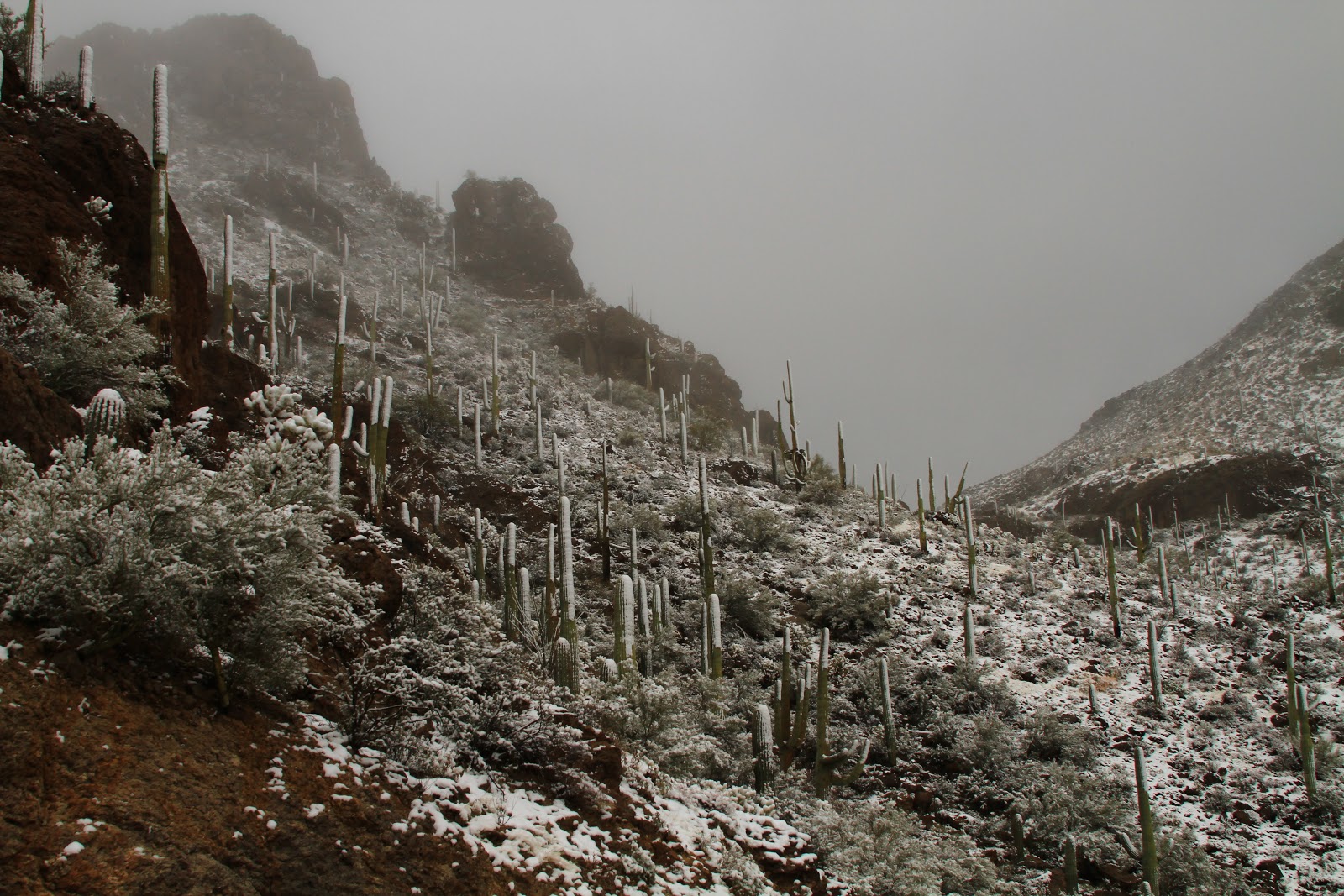
The day after it snowed off and on covering the landscape the white stuff had melted away leaving a fresh new look behind. Snow was still evident on the mountains especially at the higher elevations but even this would be short lived and by the middle of the afternoon Golden Gate Mountain pictured above was completely bare.


This photo was taken from Saguaro National Park looking west out across the valley toward Kitt Peak  which can be seen still covered in snow. The saguaro in the center of the photo has multiple arms which start to develop at around sixty-five years so I would estimate this one to be around ninety to one hundred years old.


It's especially nice to hike in Saguaro National Park West this time of year with the temperatures today in the fifties. It's a short drive from my house and the park has panoramic views and many hiking trails and a diverse compliment of plants and animals.


Kitt Peak which can be seen in the background is over fifty miles away. Route 86 which heads west towards California takes you through the Tohono O'odham reservation where the world class Kitt Peak National Observatory is located at the summit. I have visited the observatory a few times and I will tell you it's worth the trip. http://www.noao.edu/kpno/


What a difference a day makes here in the desert. In a couple of days it will push into the seventies and very soon the wildflower season will color the landscape in yellows and pinks and purples.I have to say I simply cannot wait. I have included a link to the park if you're interested in visiting the saguaros. http://www.nps.gov/sagu/index.htm

More Winter Saguaros


Here are some additional photo's that were requested by an avid plant person from Costa Mesa California. Seeing snow covered saguaro's is a rarity and you have to be quick to get out as the snow only lasts a very short time, as a matter of fact it melted away so quickly that I didn't get to shoot one whole section of the park that I had planned on visiting. It could be years before we see this again although with the climate changing so rapidly it's possible that it could become more or less frequent. I have seen photo's from the early years in Tucson and there was more snow in the past then we see these days.


It's terrific to have such a beautiful place as my backyard and I am looking forward to the spring migration and hopefully an abundant wildflower season as well.


Here is some information on how saguaros grow. http://www.nps.gov/sagu/naturescience/how-saguaros-grow.htm