Sunday, October 23, 2011

New England


We have just returned from our trip to Connecticut, Massachusetts, New Hampshire and Maine. We landed in Connecticut and traveled our one rainy day up to the New Hampshire coast and then on to Rockport Maine. It was great to be home again as I hadn't been back in over four years and it was with great anticipation that I looked forward to seeing my family and friends again.

The New Hampshire coast was grey and sullen and beautiful with it's 13 miles of exceptional views of the open ocean and marshes. We lingered as much as the rain would allow and I photographed these very familiar scenes from my past.
Standing on the shore looking out over the ocean is both wonderful and disturbing. The rhythm of the waves, the sudden crash against the rocks, the feeling of belonging, of being home again juxtaposed with a great sense of loss and the sense of an underlying, unseen tragedy. The abundance that once was no longer is, an abundance that is I fear is lost forever. Still I love this place and I can't help but hope that people will come to their senses and find a way to save the oceans of the world by giving them the help they need to recover from the relentless destruction of the last century.
Our second stop was Rockport Maine where we would stay with family and have some time to check out Camden and Rockport harbors. As luck would have it the weather cleared and  photography would be much easier without the rain.


I made a couple of visits to Camden Harbor on a truly beautiful day. Camden is one of those famous Maine coastal towns that is picturesque everywhere you look. I have to admit that I've always enjoyed boats and in my youth I spent a summer working in a Maine shipyard building a 99 foot ferry boat and a 138 foot cruise boat.


Next we headed to Rockport Harbor which is more of a working harbor. There is a statue to Andre the seal who adopted a local family and had a movie made about him..


Returning to the village where I lived before coming to Arizona is always special to me. After stopping by the cemetery to visit my Mom and Dad's grave we headed to the Sheepscot River which is one of the most beautiful places on earth. I was fortunate enough to live in the Sheepscot Village for a total of four years and was always happy there.


 I loved it here and some times I wish I had never left but the world is so big and there is so much to see.............


Well it's tomorrow and I have added photos from Rachel Carson National Wildlife Refuge in Wells Maine. Our walk through the refuge is just a small part of the total acreage set aside to protect migratory birds and preserve the coast in it's natural beauty. I found the following description of the refuge at the US Fish and Wildlife site.

Rachel Carson National Wildlife Refuge: A safe haven for wildlife

Rachel Carson National Wildlife Refuge was established in 1966 in cooperation with the State of Maine to protect valuable salt marshes and estuaries for migratory birds. Located along 50 miles of coastline in York and Cumberland counties, the refuge consists of eleven divisions between Kittery and Cape Elizabeth. It will contain approximately 14,600 acres when land acquisition is complete. The proximity of the refuge to the coast and its location between the eastern deciduous forest and the boreal forest creates a composition of plants and animals not found elsewhere in Maine. Major habitat types present on the refuge include forested upland, barrier beach/dune, coastal meadows, tidal salt marsh, and the distinctive rocky coast.


We had a truly wonderful afternoon walk and I can't wait to return and explore the rest of the refuge in the near future. So many places to see and so little time.


The foliage had only just begun to turn as we headed back down the coast and while it was a little disappointing not to see brilliance of the New England annual display this place is so special that it's natural beauty overcomes my senses in any season and reminds me of who I am and what I am all about.


 I have spent many, many days and nights here at Wells Beach walking the wonderful sandy beach from end to end stopping for fried clams every now and then. Some of my best memories of my life with Nancy were here in the great state of Maine.

I plan on making the Massachusetts portion of our trip a separate post hopefully this coming weekend. This part of the trip is the area where I grew up and went to high school. Should be fun!


Sunday, October 16, 2011

Connections

In the truest sense we are all connected, bound to a small planet in this vast universe with very limited resources. We have limited space, limited food, limited drinking water, and if nothing changes a limited future.
Plants and animals are disappearing at an alarming rate, the oceans are on the brink of collapse, our energy choices are polluting the air we breathe and the water that sustains our existence. Our choices are causing a global shift toward hotter climates and much more severe weather. Everywhere you look our world is out of balance, spinning out of control and losing the very essence of what it once was. Even those of us who consider ourselves good stewards of the earth are constantly having to re-evaluate the choices we make as we come to realize that in our everyday lives we are unwittingly supporting those among us who are destroying our planet for personal gain. We are connected. Connected to those whose actions are causing irreparable harm to our world.
It's in the food choices we make, the tuna fishing that kills the dolphins, it's the shrimpers that are killing the sea turtles, the cattle ranchers that are overgrazing the public lands and killing the wolves. It's the toilet paper and tissue we use that comes from old growth forests, it's the fracking and the coal and the oil and it's the mining and it's the chemicals we spray relentlessly on our lawns. It's so many things that it would take forever to list them all. All of these things connect us to the people and the corporations that prey on the environment for a personal wealth that is nothing short of obscene.
It's the choices in our everyday lives that have made billionaire moguls of bad guys and bad companies. There will always be people willing to do long term damage for short term gain and they are counting on you not being a savvy consumer who stops and thinks about where the product came from and who's behind it and what is the environmental damage associated with it is. Would you really continue to eat tuna from a company that is using methods that kill thousands of turtles, sharks and other species and is depleting the ocean stocks of tuna to a dangerously unsustainable level? When you throw those steaks on the barbecue do you stop and think about the wolves that are being eradicated by ranchers?
The truth is we have built a world on unsustainable practices and we have now reached the crossroads for the entire planet. The big guys make the kind of choices that damage the environment because they are not held to account by the consumer. They are not held to account by you.
The question is what can we do about a world system built on the total annihilation of species after species? What can we do about people and corporations that believe only in the accumulation of wealth even beyond what they could ever spend in many lifetimes.
The answer  is amazingly simple! Stop buying what they are selling. Knowing what you are actually buying and learning which companies are good stewards of the earth is a good start. Joining organizations like Greenpeace or the NRDC will also help you to become a more informed consumer. Just a little research on your part will help you to help save the planet. Remember reusing and recycling are great but not buying it in the first place is better!

Saturday, September 17, 2011

Season's First Visit to Whitewater Draw Conservation Area

We made our first visit of the season to Whitewater Draw on last Saturday arriving just after sunrise on a beautiful, cool ( upper 60's ) morning. Conditions could not have been better as it had rained the night before and no one else was around so at least for a short while Whitewater would be ours to enjoy in solitude.
As you might already know Whitewater Draw is a great place to see the Sandhill Cranes that winter here in the south of Arizona near the Mexican border. After some deliberation and an absolutely wonderful visit there I have decided to continue to my series that I began last October on the Sandhill Cranes.
As a photographer and nature lover I never tire of seeing these amazing creatures up close and although I have some great shots already I know that the quintessential moment is still to come and hopefully I'll be able to capture it.


There were no cranes spotted on this visit but there was plenty to see and it was such a nice morning that we went about our business encountering the small joys that a place like this is rife with including the tiniest frogs I have ever seen and a Great White Egret landing gracefully to feed in the marsh grass.


Bird watching at Whitewater Draw always provides some nice surprises like the flock of White-faced Ibises that flew around us and landed mostly beyond the reach of my 300 mm lens. White-faced Ibises are the western counterpart to the Glossy Ibis which would be considered rare if it was spotted here. It is not unheard of so I am hopeful that someday I'll have the chance to see one here in Arizona.


This is the time of the year that I have been waiting for, a time when the 100+ degree heat diminishes and the humidity begins to abate making outdoor adventures possible once again. If you have never experienced a southern Arizona summer it is hard to imagine a more hostile environment if you are not totally prepared for it. Although monsoon season can be oppressive it is also extremely beautiful with it's spectacular sunrises and sunsets, it's puffy white clouds that build into afternoon downpours and fierce thunder and lightning.


The most amazing thing about being here this time of year is the winged migration that is beginning all around me. So many amazing places to go and enjoy birds as they head back southward in search of food. While most people think of the desert as devoid of life just the opposite is true. There is so much life here including the millions of birds that pass through here each year.


I see quite a few Great Blue Herons in my travels but this one almost went un-noticed as they tend to blend into the marsh.


I have always seen flocks of blackbirds as a harbinger of autumn both in the northeast when I lived there  and here in the southwest. There is nothing that says fall like the large undulating masses of birds that seem to have a single mind in the air.


If you have ever been to Whitewater after it has rained recently than you know that the walking is a little on the difficult side as mud sticks to your shoes and ends up weighing about five pounds on each foot after a short distance. It does not take away from the beauty all around and we were fortunate to have the place to ourselves for our entire visit.


It takes some effort to get to Whitewater as it is not just off the highway but it is well worth the effort especially when there are thousands of Sandhills present but you never know when you might see, say a Great Horned Owl or two!

Monday, September 5, 2011

Sweetwater Morning

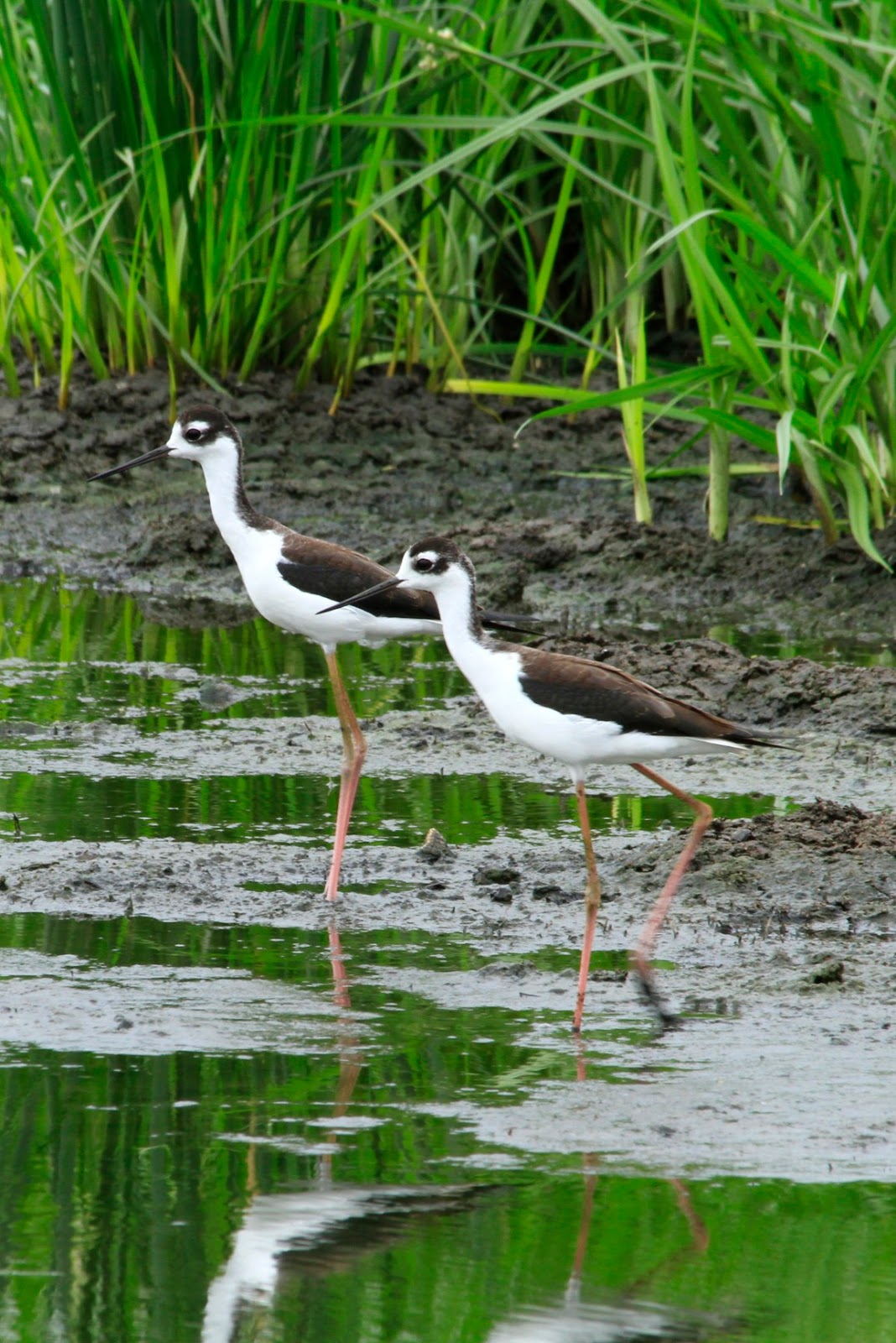
Thought people might like to see the birds that you can find in central Tucson Arizona. I spent about 90 minutes walking around Sweetwater Wetlands this morning amazed as usual at the variety of birds that are attracted to water here in the desert.


Black Necked Stilts


Female Mallard

Saturday, September 3, 2011

Anatomy of Two Arizona Storms

If you can imagine it we Tucsonans are longing for the temperature to drop below the century mark into the 90's. Monsoon weather lingers and everyday this week is likely to be 102 degrees or above. Fortunately this produces some fairly spectacular opportunities to photograph the unique storms that arrive in the afternoons here in southwest Arizona. Recently I photographed storms in Tucson Mountain Park adjacent to Saguaro National Park West and atop Kitt Peak the world renowned observatory located on the Tohono O'odham reservation 35 miles west of Tucson.
On August 19th on my way home from work I spotted this storm as I drove up Ajo Way . I decided it was defined enough and the entire system was visible so I grabbed my camera and ran out to the park which is directly behind my house to see if I could get some decent photos. The following four photos are in sequence as the storm moved from the south toward the north as they often do here.

Most rain during monsoon season here in the Sonoran Desert are not wide spread but rather "scattered" and while it was raining quite hard towards the mountains as you can see it was not raining at all in the location where I was standing to take these photos.
A typical monsoon day as I have observed it starts out with early morning scattered clouds that turn pink and red for a very brief time as the sun rises above the horizon in the east. Depending on the amount and placement of the clouds it can be very beautiful if only for a few fleeting moments.

Storms like these along with the more sedate winter rains are responsible for the incredible diversity of plants and animals here in southern Arizona. Some areas get substantial rain while others are completely passed by and people frequently comment on the torrential rains of the previous day that I had no idea even happened because my little corner of the world remained dry this time. These storms in summer are frequently accompanied by thunder, lightning and high winds that are sometimes extremely violent and do major damage to property and this year have torn down many electric poles leaving residents without air conditioning for hours and days in 100+ degree heat.

The next storm of interest was one that I photographed atop Kitt Peak on what I can only describe as a beautiful, sunny day that was a little too hot at 6000 feet above sea level. As this first picture will show there was not a cloud anywhere to be found at 10:30 A.M. as we ascended the mountain seeking relief from the temperature on the desert floor which was approaching 100 degrees.


One thing that I really enjoy here in the desert is the vast openness of the valley where it is not uncommon to be able to see for hundreds of miles from the right vantage point. I also love the vast blue skies.

At 10:45 we began to see the "puffy whites" forming over the valley in front of Baboquivari which is the sacred mountain of the Tohono O'odham tribe.

Kitt Peak rises 6000 feet above sea level and the views are spectacular on most days. As you can see by 11:13 A.M. the clouds were expanding but still not covering the blue,blue sky.

11:19 A.M.The solar telescope is the mot unusual one on the skyline and give you an idea of how close to the clouds you are standing atop Kitt Peak. I love visiting here just for the view but there is plenty to see including the telescopes, many of which allow you inside for a visit. Kitt Peak Observatory also has many programs during the year that you can read about here: www.noao.edu/kpno/ .

At 11:45 A.M. we are starting to see the energy building out over the valley as the clouds are adding height and darkening just a little.


By12:19 P.M. the first columns of rain and a few lightning strikes appeared in the greatly expanded as well as darkened cloud mass.

12.21 P.M.
12:27 P.M.

12:30 P.M. It's certainly has grown into a force of nature in a very short time and it was really terrific to be able to see the whole process from the top of Kitt Peak.

12:34 P.M A curtain of water has developed from what a short time ago seemed like an empty sky. Amazing!


California Condor Release in Arizona

On September 24th 2011 three California Condors will be released at Vermillion Cliffs in northern Arizona. The public will be allowed to view the release at 11:00 A.M. from a predetermined viewing area.
California Condor Sweeps the Grand Canyon
More information on the release can be found at the Peregrine Funds website here: www.peregrinefund.org/news-release/217

Rescued and Released in Key West


Sarah releases our Swallow-tailed kite into the air just south of Fort Taylor so it can rejoin the migration to South America. A large kettle of Swallow-tailed Kites was seen heading south soon after this release. This bird was rescued by the crew of The Piscivorious a few miles off of Key West.
By: Key West Wildlife Center

Sarah (my daughter) makes me proud once again. It is people like Sarah around the country that do the day to day hard work involved in saving the planet from all manner of ecologic catastrophe. I can't help but notice the joy in her expression as she releases the Swallow-tailed Kite to resume it's interrupted journey to South America. Kudos to the crew of the Piscivorious!
You can learn more about the Swallow-tailed Kite at: www.allaboutbirds.org/guide/Swallow-tailed_Kite/lifehistory

Sunday, July 31, 2011

A Generation that "Could but Wouldn't"

Will we will be the generation that future generations blame for failing to protect the earth. Will we be the generation that could have saved the planet but decided not to?


Each day dozens of e-mails hit my inbox attesting to the perilous state of our environment and the deplorable state of some of our most endangered species. The gray wolf is under attack in many states where complete annihilation is the only thing that will satisfy the cattle industry. The only wild buffalo herd left in the United States is being systematically hazed and killed by those we entrusted with their care. Whales continue to be killed by Japan and Iceland. The oceans are approaching collapse. The National Parks are being starved of funds needed to keep them healthy as mining and gas and oil interests continue to try to encroach on these magnificent places with little regard for the consequences. Our air and water is being polluted at an unbelievable rate and our congress is trying to roll back most of the environmental safeguards that we have managed to put in place over the past few decades.
Politicians pander to those interests that have the deepest pockets, caring little for the future of our country and the world. In some circles environment is a dirty word and cash is king. Many of our leaders seek to undo any regulation that stands in the way of an absolute and total plunder of our resources with little or no regard for the other species that inhabit our planet.


Many sit back watching it happen and it is happening. It's picking up speed , moving at an unprecedented pace toward an irreversible outcome. Imagine a world without eagles, a world without ponderosa pines, a world where every storm turns violent, imagine a world without polar bears, or seals, or hammerhead sharks, one with no whales, no salmon, no sea turtles. All of these things are possible if nothing changes. If we continue to ignore the truth of our planets final chance at redemption then the future is bleak and generations to come will curse our lack of action.

We must get involved now. We must speak out now. Please join an organization that works to protect nature or volunteer at a preserve or perhaps a national park. Become politically aware and help elect environmentally friendly politicians.We must save the eagles, the wolves, the fishes in the oceans and we must do it now or we will become the generation that "could have saved the earth but wouldn't".

Photos taken at Madera Canyon south of Tucson, Arizona.

Sunday, July 17, 2011

Monsoon Season


The rains finally came here in Tucson Arizona. Their brief but welcome stay was the most violent that I had experienced here in the Sonoran Desert. High winds and torrential rains came in the early evenings on several days inside a single week damaging buildings, knocking down power poles and creating rivers across many of the roads. At times there was one to two feet of water in intersections with no traffic lights to guide us. A major dust storm (haboob) was spawned here in Tucson which then traveled northward and engulfed all of Phoenix, truly an amazing event certainly aided but the very dry conditions in the desert. www.huffingtonpost.com/2011/07/06/phoenix-dust-storm-photos-video_n_891157.html
With all of the inconvenience that the rains bring I was happy for the many animals and plants that have had to struggle to find water during this very serious drought period. A period so serious in fact that national forests were closed due to extreme fire conditions from a lack of moisture, a first since we came here to Tucson. Over 500,000 acres burned in multiple fires across the state including the Sierra Vista fire which leveled many homes and businesses as it marched across the parched earth. I watched the tragedy unfold in Sierra Vista and could not believe how fast thousands of acres were lost.
The rains have left us at least for the time being and the small watering hole that we provide outside our window remains busy with visits from coyote, rabbits, mule deer, all manor of birds and I'm sure many night visitors while we sleep as the water seems to disappear when we are not watching. Birds come to drink and bathe all day long and in the evening the rabbits gingerly approach including our very special three eared one that has been a regular for some time.
I am hopeful that the rains will return soon as the temperatures exceed 100 on most days this time of year and have reached as high as 111 degrees on occasion. Can you imagine temperatures over 100 degrees and not being able to find adequate water? What must it feel like to be thirsty in that kind of environment? Perhaps it's time to stop denying mans impact on the environment, time to admit that global warming is real and that we can and should try to do something about it before it's too late.

P.S. I just startled a coyote getting a drink outside my window.